
ARTIFICIAL MIND INSIGHTS · 12 NOVEMBER 2026
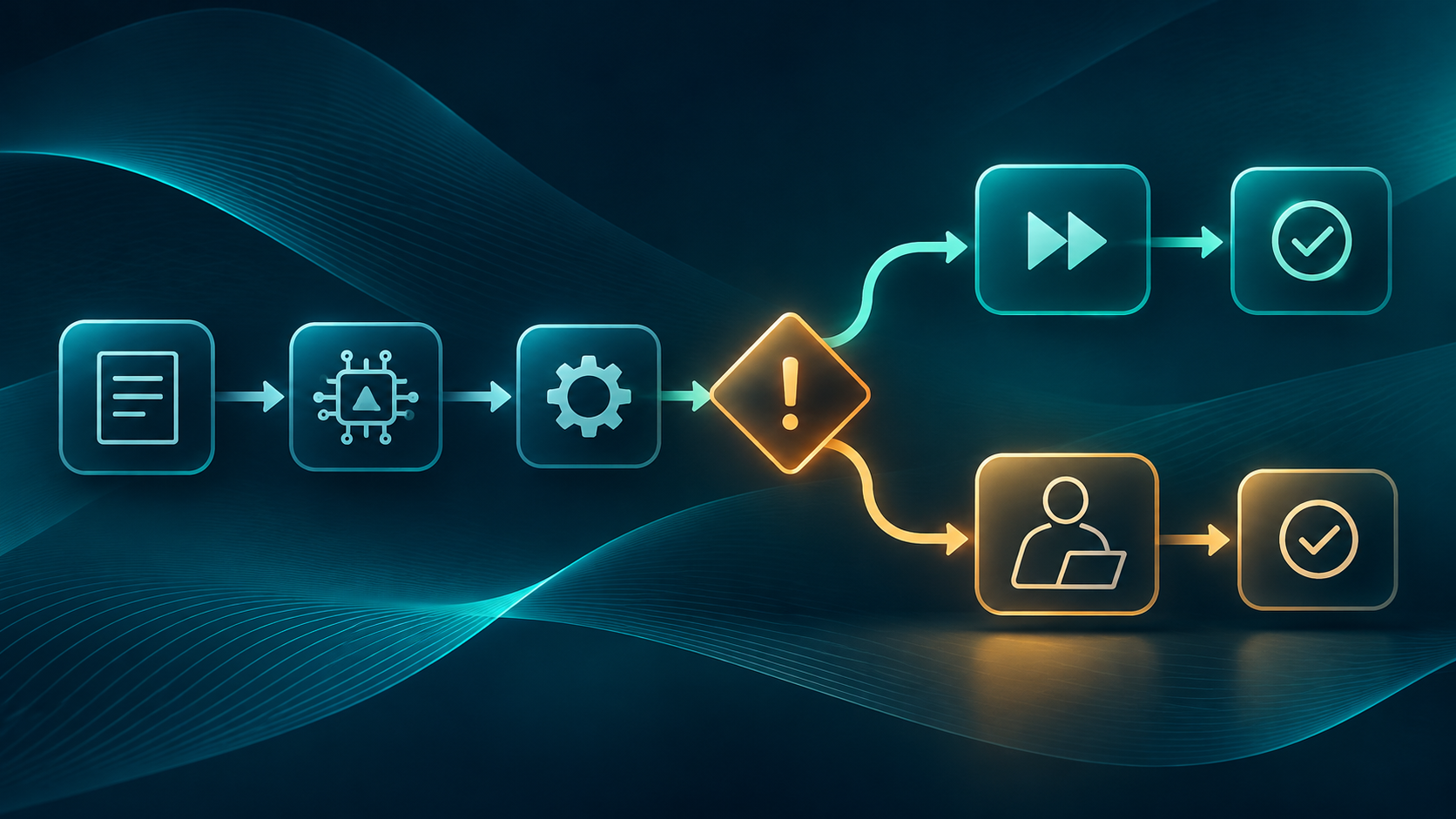
AI is becoming part of everyday operations. But what happens when the workflow doesn’t follow the plan?
An AI agent processes a customer request. It retrieves information, updates a system, and prepares the next action. The process works, the response is fast, and the team sees an opportunity to scale.
Then something unexpected happens.
The information is incomplete. Two systems disagree. A customer request falls outside the standard conditions. Or the agent proposes an action that technically fits its instructions but creates a business risk.
Who notices? Who decides? And what happens to the work while everyone is figuring that out?
These are not exceptional questions. They are operational questions that become increasingly important as AI moves from isolated experimentation into business processes.
The difference between a successful task and a reliable operation
Many AI initiatives begin by demonstrating that a task can be performed faster or with less manual effort. That is a useful starting point. But it tells us relatively little about how the process behaves under real operating conditions.
A demonstration usually involves a defined objective, reasonably clean inputs, and a limited number of scenarios. Operational environments are different. Customers behave unpredictably. Information is missing. Business priorities change. Systems become temporarily unavailable. Policies conflict with commercial opportunities.
A reliable AI-enabled process must handle these situations without losing control of the outcome. That requires more than a capable model. It requires an operating model.
The exception is where the organisation becomes visible
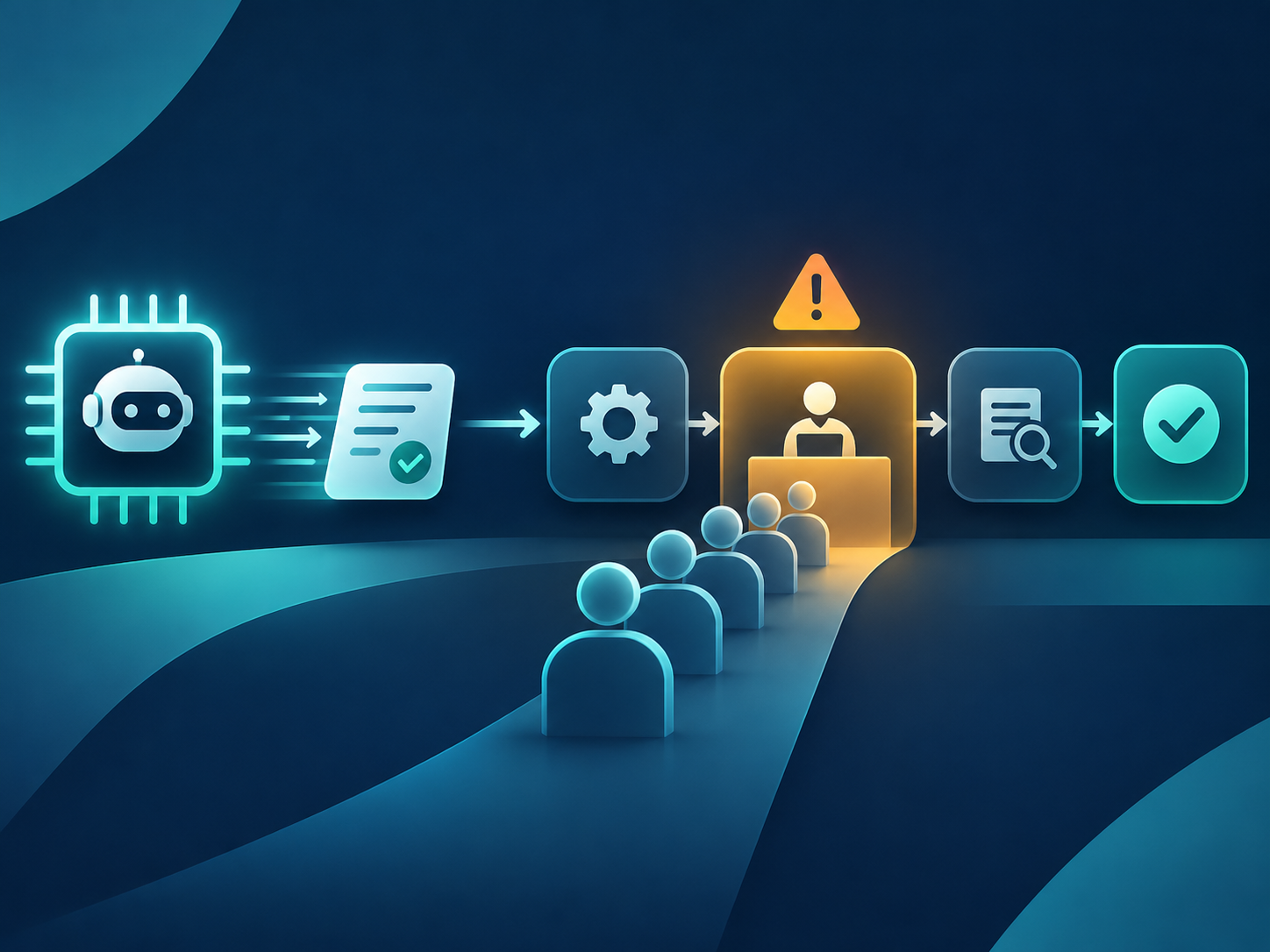
Consider an AI agent supporting a customer service team. Under normal circumstances, it classifies requests, retrieves relevant information, and prepares responses. Now imagine a customer requests an exception to an established policy.
The agent might identify several technically plausible responses. But choosing between them may involve commercial judgment, contractual obligations, customer relationships, and reputational consequences. Those decisions cannot be resolved simply by making the agent more capable.
The organisation must establish where its authority ends and where human judgment begins.
- Which situations can the agent resolve independently?
- What conditions require escalation?
- Who owns the decision once a case is escalated?
- How does the work continue while a decision is pending?
- What evidence is retained so the outcome can be reviewed?
Without clear answers, automation may accelerate routine work while creating new queues, hidden dependencies, and unresolved exceptions elsewhere.

More governance documentation is not necessarily the answer
It is tempting to respond by adding another policy, approval layer, or dashboard. Sometimes that is necessary.
But a policy that exists only in a document does not determine what happens when an agent encounters an ambiguous situation at 4:45 on a Friday afternoon.
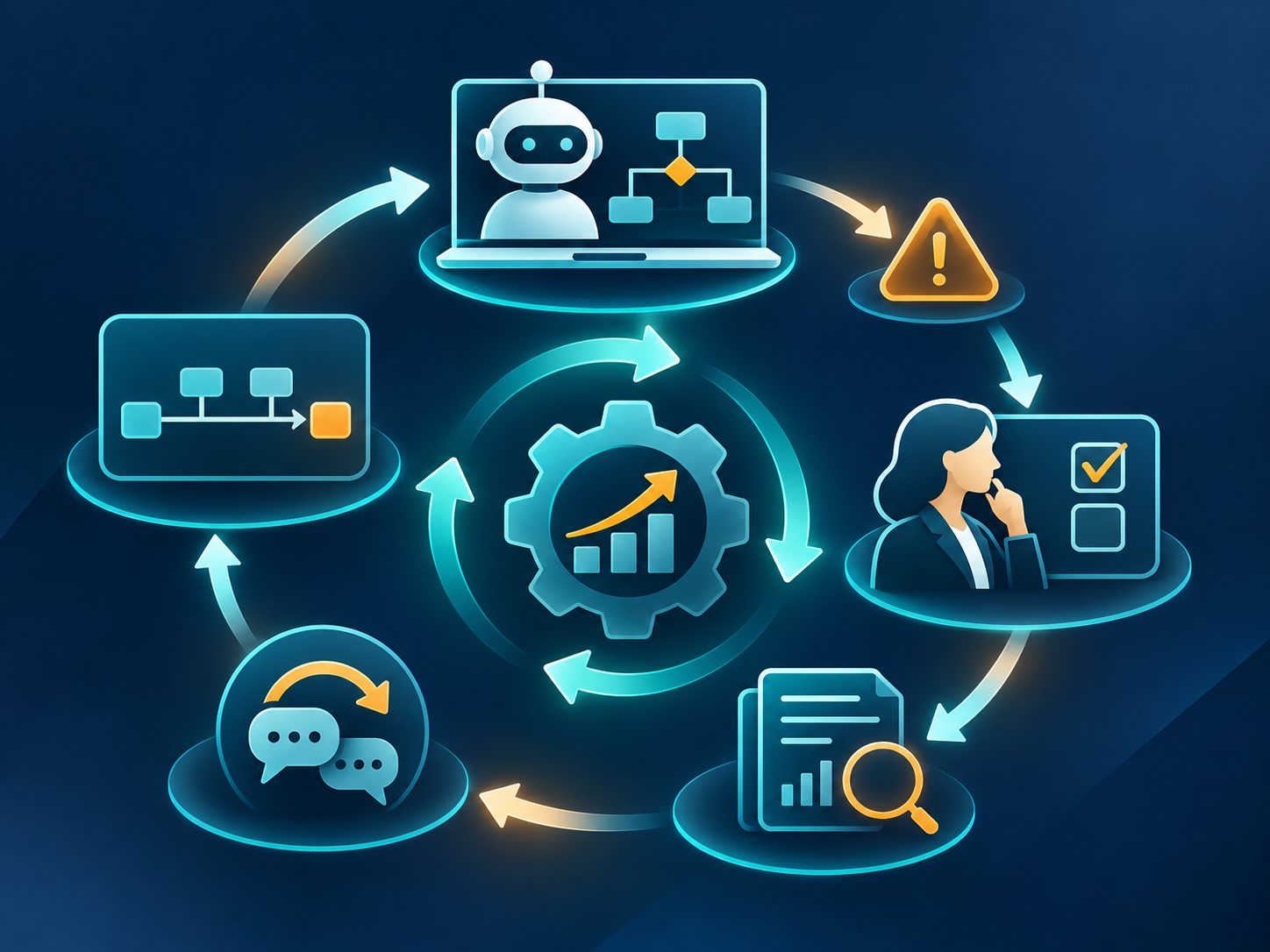
Effective governance has to be embedded in the workflow itself. The agent needs defined operating boundaries. The process needs a reliable escalation route. The responsible person needs sufficient context to make a decision. And the organisation needs a way to learn from recurring exceptions.
The objective is not to require human approval for every action. It is to make human intervention meaningful where it matters.
Design for exceptions before scaling
A practical starting point is to examine one AI-enabled workflow and identify its most consequential exceptions.
- Define the decision boundary. Separate routine execution from decisions involving significant financial, legal, customer, or operational consequences.
- Make escalation actionable. Specify the owner, the required information, the response expectations, and what happens while the case is waiting.
- Preserve the decision context. Record what triggered the exception, what information was available, which decision was made, and why. Keep the evidence proportionate to the risk.
- Test the difficult scenarios. Do not assess the process only with successful examples. Test incomplete information, conflicting instructions, unavailable systems, unexpected requests, and attempted actions outside the permitted scope.
- Learn from recurring exceptions. Repeated escalations may reveal an unclear policy, poor data quality, an unsuitable workflow design, or an opportunity for carefully bounded automation.
The aim is not to eliminate every exception. It is to make exceptions manageable, visible, and useful for improving the process.
Measure the whole workflow, not just the agent
An agent may complete its assigned task in seconds while the overall process still takes days. That is why local productivity measures can be misleading.
Useful measures include end-to-end completion time, exception frequency, time to resolution, rework, human intervention, quality of outcomes, and actual business value. These measures should be compared against an appropriate human-only or existing-process baseline.
Otherwise, organisations risk celebrating faster activity without demonstrating better performance.
This distinction is increasingly relevant. Research on enterprise AI adoption highlights the difference between individual productivity improvements and measurable organisational outcomes.
The implication is straightforward: the value of AI must be assessed at the level of the business process, not merely the individual automated task.
From AI adoption to operational responsibility
The next stage of AI transformation will not be defined solely by how many agents an organisation deploys.
It will be shaped by how reliably people, processes, and AI systems work together when conditions are less than ideal.
That requires clear decision rights, practical escalation mechanisms, relevant evidence, and continuous learning.
The real test of an AI-enabled workflow is not only what happens when everything goes right. It is what the organisation does when something doesn’t.
And that is a leadership and operating-model challenge, not merely a technology challenge.
A question for leaders
If one of your AI-enabled workflows encounters an unexpected situation tomorrow, is it clear who makes the decision — and how the work moves forward?
Sources & Further Reading
NIST — AI Risk Management Framework
ISO/IEC 42001 — AI Management System
Artificial Mind Insights explores AI adoption, enterprise transformation, responsible AI, governance, and measurable business value.
Milo Izzinosa | Founder & AI Transformation Lead — Artificial Mind Solutions
 English
 Nederlands
 Português