
ARTIFICIAL MIND ARTICLE • EXECUTION, ADOPTION & VALUE REALISATION
From AI Use Case to Working Capability: Deliver, Learn and Scale
Most organisations do not struggle to generate ideas for AI. They struggle to choose where to start, change the surrounding work and prove that the result justifies further investment. That is why implementation and adoption belong in the AI strategy from the outset.
Start with a use case that can be tested
Choose an end-to-end task with a responsible business owner, a clear user need, access to approved examples and a baseline. Compare the current practice, a sensible process improvement without new AI and an AI-supported option. If there is no reliable decision or outcome to improve, a broader platform programme will not solve that ambiguity.
A practical delivery loop
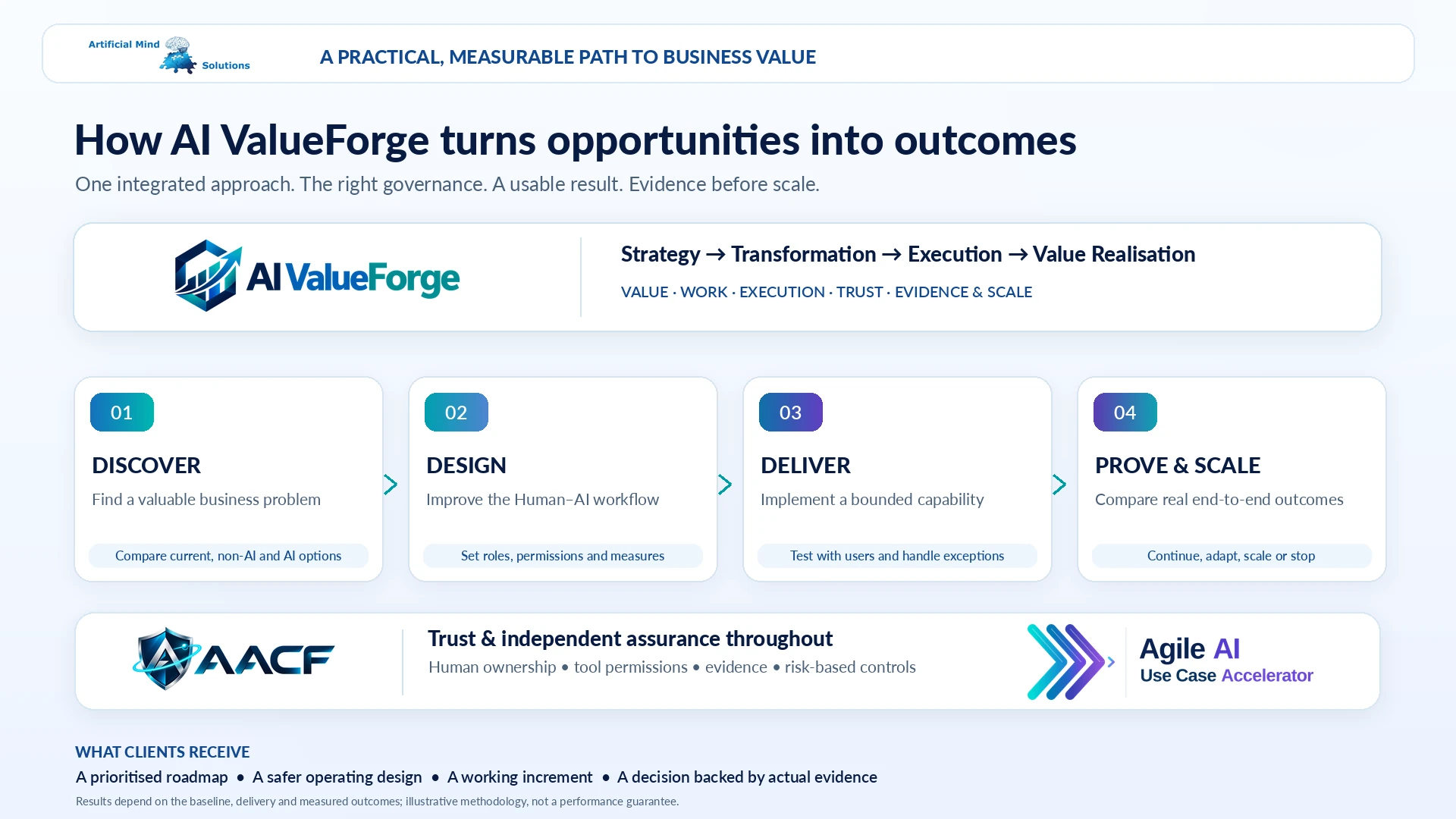
- Discover: Frame the outcome, stakeholders, current constraints, available evidence and priority.
- Design: Specify Human–AI tasks, decision rights, data boundaries, exceptions, success measures and a small testable scope.
- Deliver: Build and demonstrate a bounded capability using the organisation’s existing delivery system—Scrum, Kanban, scaled Agile or a lightweight flow.
- Learn: Test with the people doing the work, capture errors, corrections, real costs and adoption barriers.
- Scale or stop: Compare results against the baseline and non-AI alternative, then decide whether to improve, operationalise, expand or discontinue.
A Definition of Done that includes the operating reality
A working demonstration is not necessarily a working service. Acceptance should cover representative tasks, ambiguous or adverse examples, correct permissions, safe recovery, monitoring responsibilities, accessibility and a named human owner. Where AI can take consequential actions, AACF adds the necessary independent control lens.
What practical AI delivery means in practice
Within AI ValueForge, iterative delivery helps teams work in short feedback cycles, deliver usable increments, prioritise transparently and evaluate business value. Each increment provides evidence for deciding what to improve, expand or stop.
Make adoption part of the product
Users should know which decisions remain theirs, what to verify, how to challenge an AI result and who handles exceptions. Train against real work, not generic tool demonstrations. Look for correct repeat use, shorter unresolved handovers and changes in the complete outcome—not training attendance alone.
What leadership gets
A short list of prioritised opportunities, a working first increment, an accountable operating model, observed quality and effort, documented limitations and a defensible next decision. Faster delivery is an objective to test against baseline, never an assumed benefit.
A useful next step
If your organisation is evaluating AI opportunities or trying to turn an existing pilot into an operational result, discuss your challenge with Artificial Mind Solutions. We will begin with the decision you need to make—not a preferred technology.
 EN
 NL
 PT