
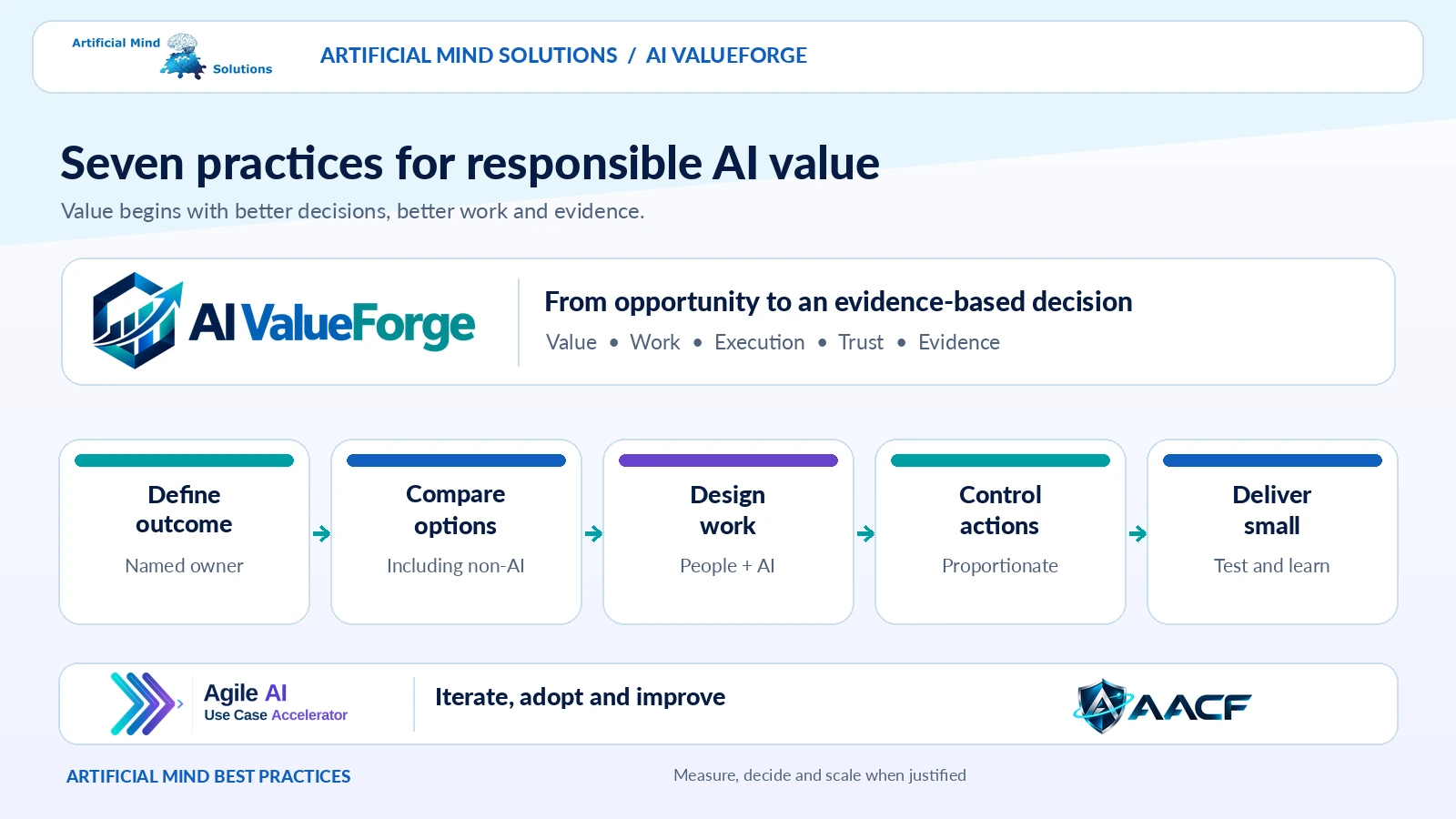
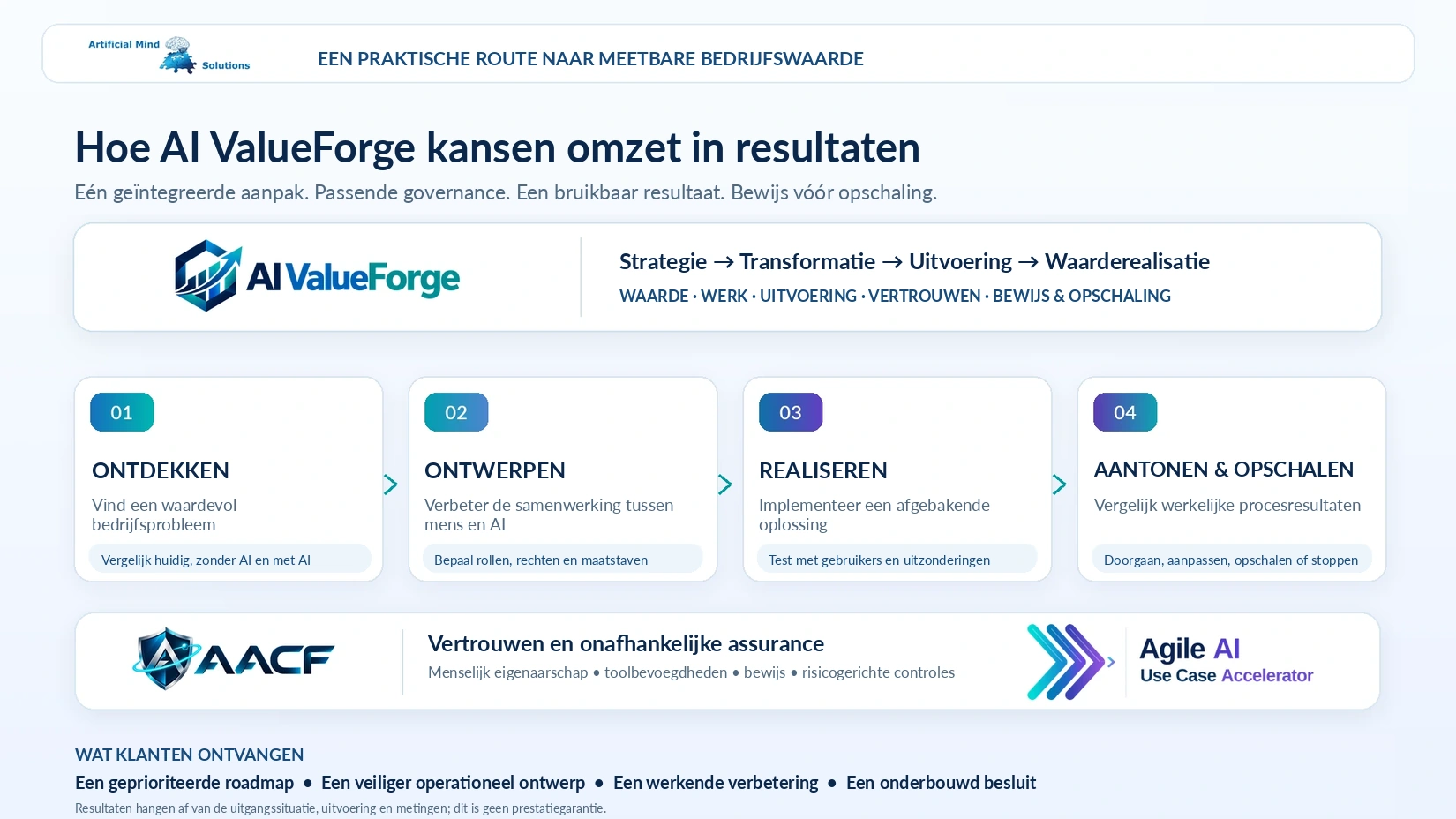
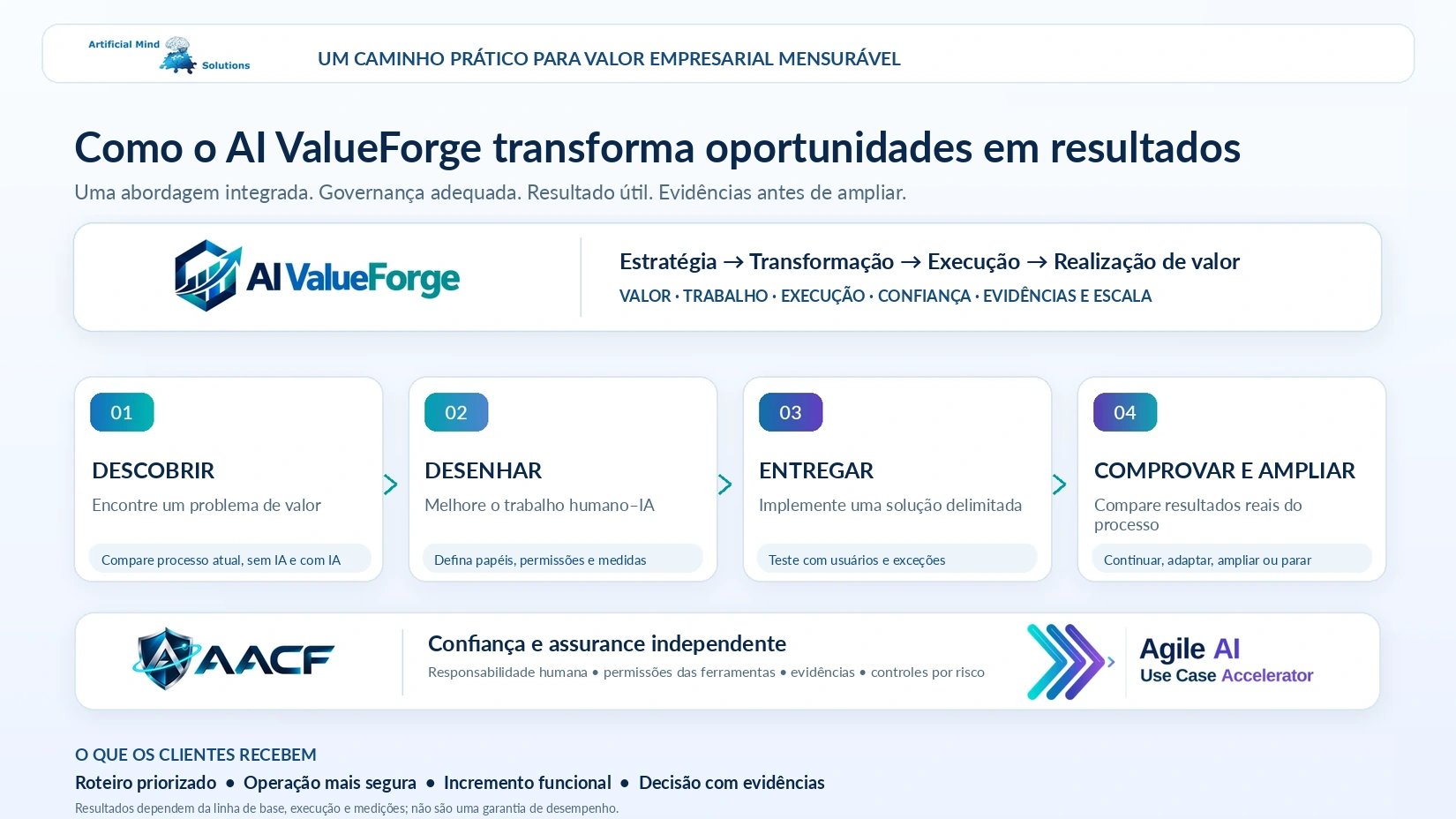
1. Agree the business result before choosing the AI
State the customer, employee or operational outcome, identify an accountable owner and collect the baseline. If no one can say what would improve, a technology shortlist is premature.
2. Compare AI with a credible non-AI improvement
Assess the current way of working (A), a process improvement with existing tools (B), and a proportionate AI-supported option (C). Compare end-to-end quality, total effort, errors, operating cost and usability on representative cases. Do not assume that C must win.
3. Design the complete Human–AI workflow
Assign tasks, recommendations, decisions, approvals and exceptions to named roles. Ensure people can challenge or correct AI outputs. Improve underlying data and handoffs before automating a broken process.
4. Keep consequential authority outside the agent’s sole control
When an agent can act in systems or on customer data, apply scope-bound access, independent authorisation, human accountability, protected evidence and recovery. Use AACF proportionately; an advisory chatbot and a payment-initiating agent require different controls.
5. Deliver one usable increment before scaling
Select a bounded, important task. Use the organisation’s current Scrum, Kanban or other suitable delivery practices to demonstrate a working improvement to its intended users. Test negative scenarios, not just the happy path.
6. Measure what happens after adoption
Measure corrected results, human checking, operational exceptions, downstream delays and ongoing support—not just model accuracy or the seconds needed to generate a draft. Record uncertainty, changes in workload and any unintended effects.
7. Make the next decision explicit
For each increment, the business owner decides to continue, adapt, stop or scale, based on actual evidence and the organisation’s risk appetite. The Agile AI Use Case Accelerator supports this ongoing execution and learning, while AI ValueForge maintains alignment with business value.
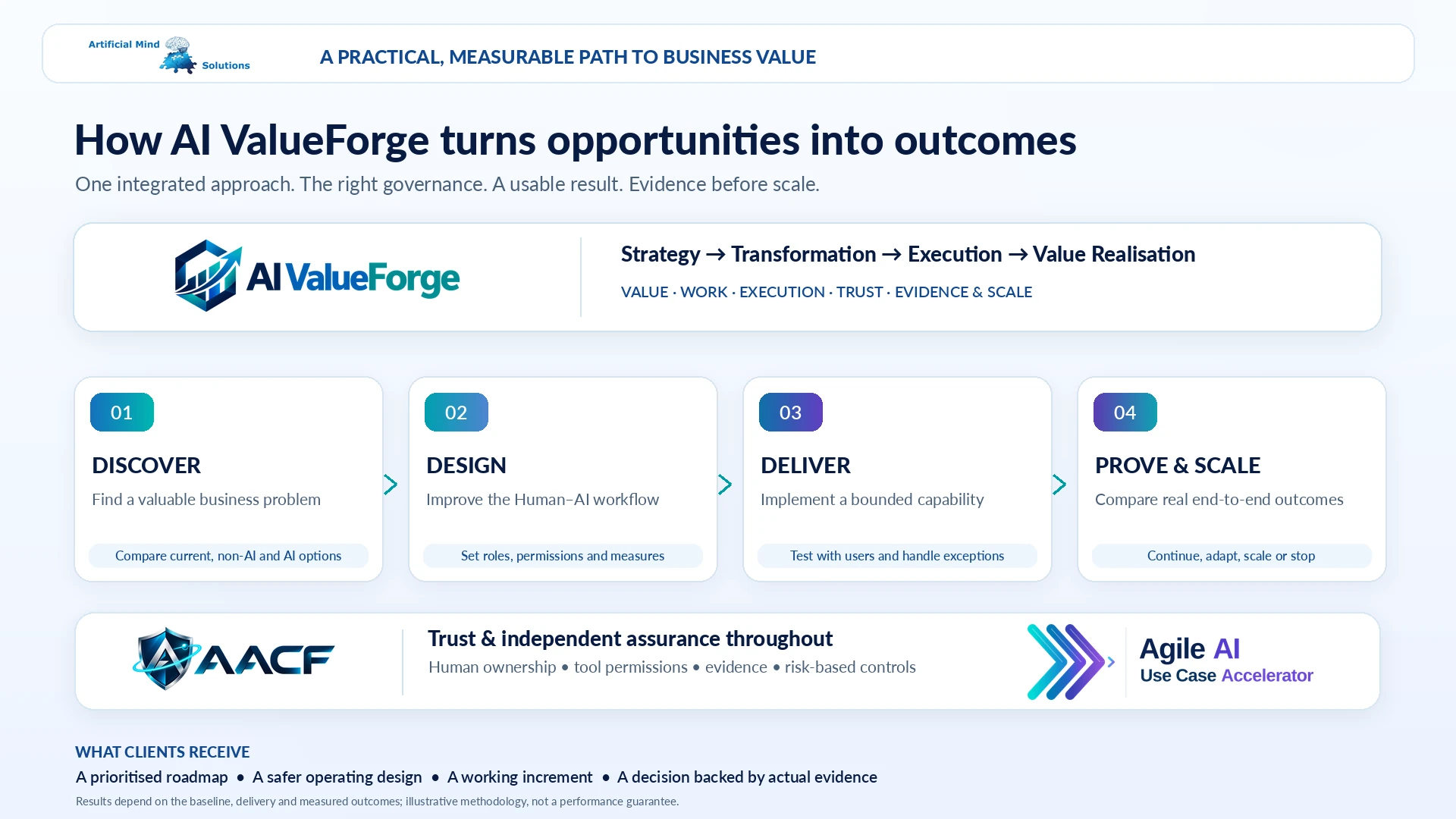
A concise executive checklist
- Is the expected outcome and accountable owner clear?
- Do we understand A, B and C before investing?
- Are Human–AI decisions and exceptions defined?
- Can consequential actions be independently controlled?
- Has a working increment been tested with actual intended users?
- Does measured evidence justify the next investment?
Use this as a discussion guide. It does not replace a scoped assessment, engineering verification or independent assurance. Requirements deepen where regulatory duties, sensitive data or autonomous tools make that necessary.
Turn principles into a practical roadmap
Our AI Transformation and assessment services help identify the decision, establish evidence needs and design a workable next step. Contact Artificial Mind Solutions to explore what is relevant to your organisation.
 English
 Nederlands
 Português