
ILLUSTRATIVE PRACTICE CASE | FICTIONAL EXAMPLE | NO CUSTOMER RESULT CLAIM
Prioritising an AI Portfolio Across Teams
This example is fictional. It demonstrates a decision and delivery approach, not a completed client project, independently verified outcome or quantified business saving.
The challenge
A multi-team organisation has dozens of proposed AI opportunities: meeting summaries, portfolio reporting, searchable policies and risk prediction. Teams already have significant cross-team dependencies and limited capacity. Leadership needs to decide where a first working improvement could have the greatest operational value without adding another competing programme.
The outcome to improve
The immediate business question is not which AI feature to buy. It is whether teams can identify and resolve delivery dependencies more consistently and with less rework. The organisation assigns an accountable portfolio owner and agrees how to recognise a verified improvement.
Step 1: examine the work and collect baseline evidence
The team observes actual dependency reviews, ticket handovers, escalation decisions and reports, including troublesome exceptions. It records the sources, missing data, review effort, elapsed time and quality of decisions. No improvement is assumed before this baseline exists.
Step 2: compare credible options
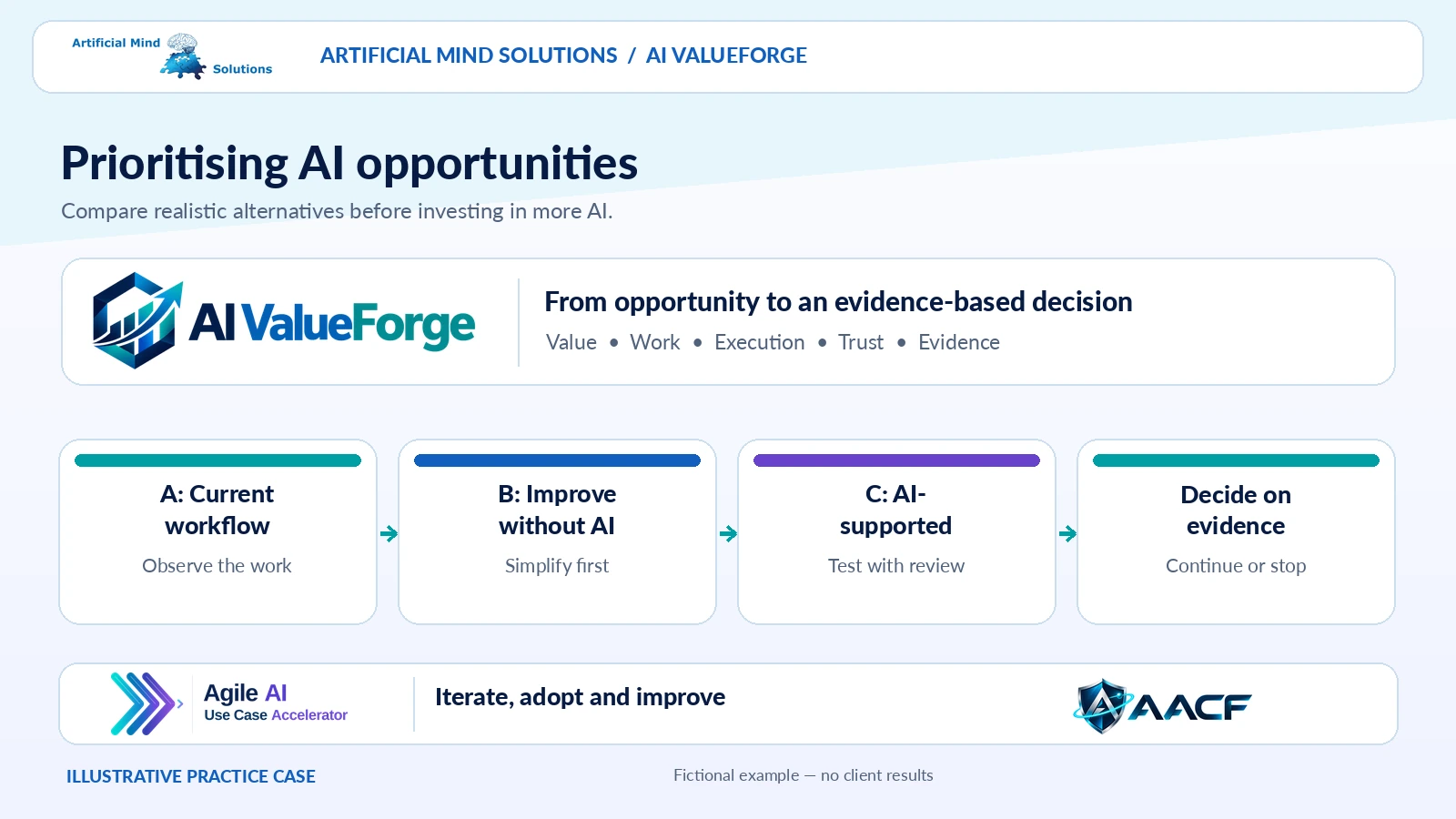
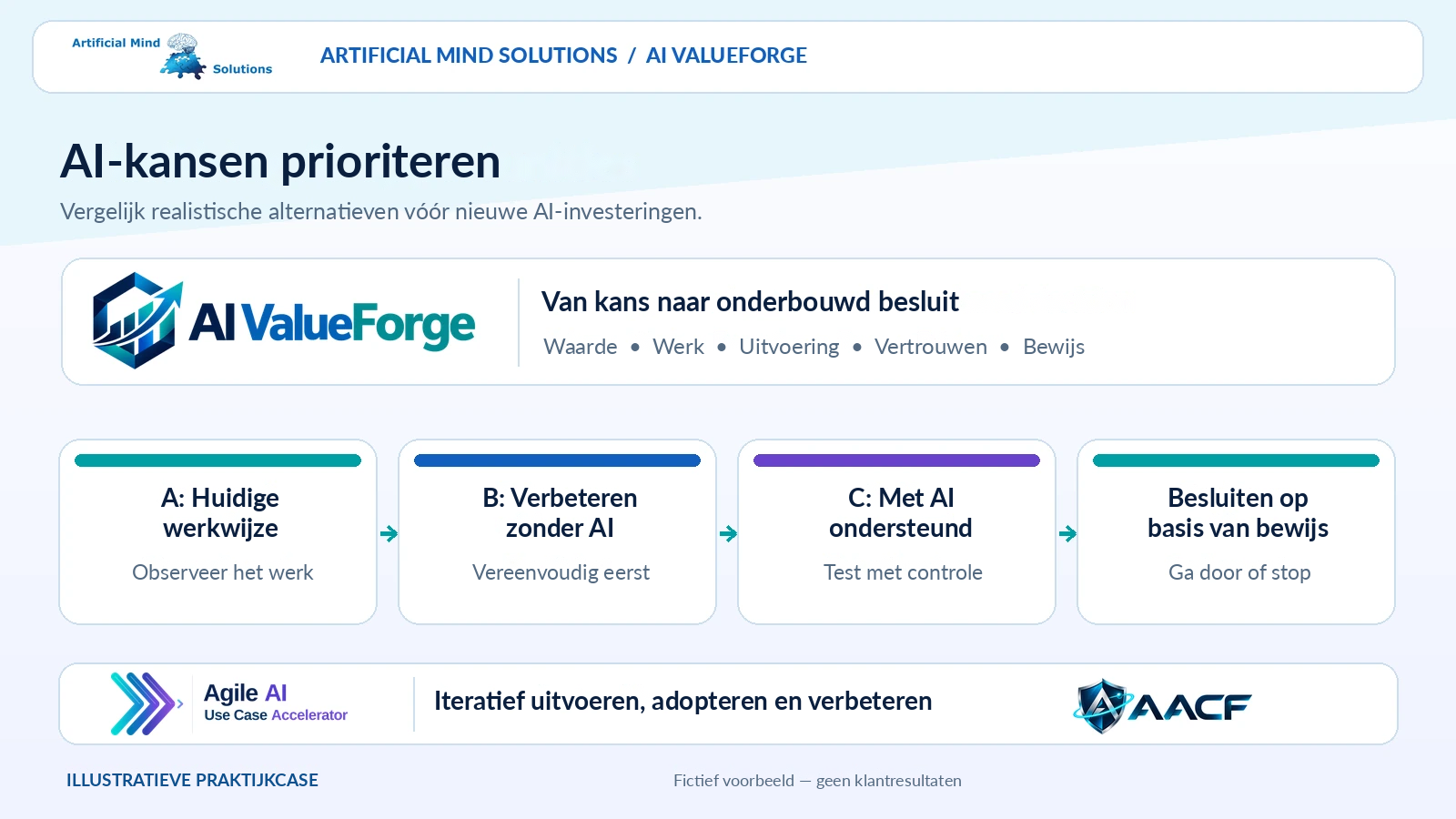
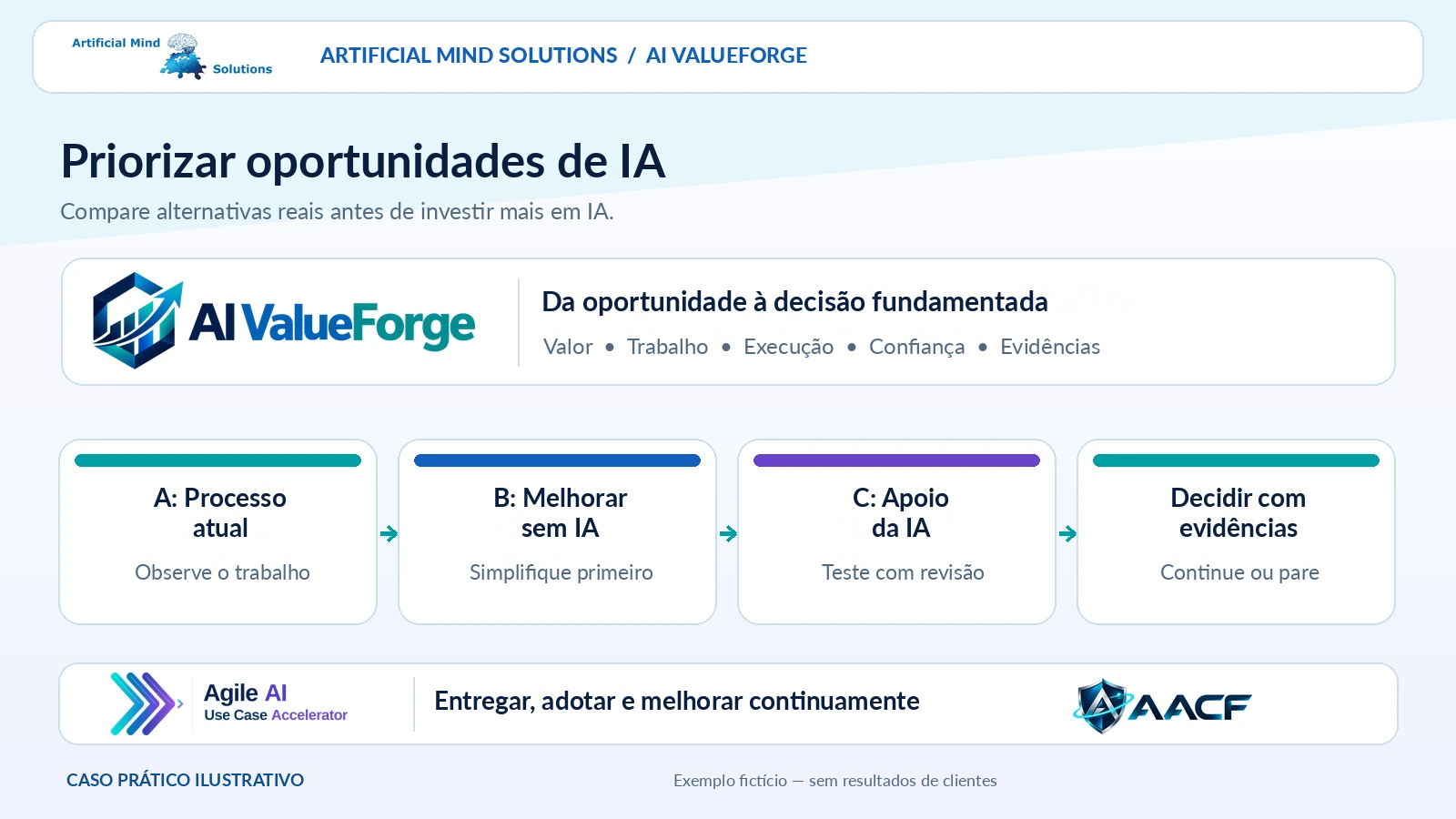
- A — Current workflow: weekly manual review of meeting notes, tickets and status updates.
- B — Simplify without new AI: standardise dependency definitions, ticket quality, clear ownership and a shared portfolio board.
- C — AI-supported workflow: use approved sources to prepare an evidence-linked draft of potential blockers for a delivery lead to verify, correct and approve.
Step 3: deliver and adopt a useful increment
The first deliverable could simply be a reliable shared board. If it does not solve the problem, the team tests a limited draft-only AI summary on representative approved data. Existing Scrum, Kanban or scaled Agile arrangements determine the delivery cadence; an entirely new method is not required.
AI ValueForge structures value, work, execution, trust and evidence; the Agile AI Use Case Accelerator helps frame iterative implementation and learning. AACF becomes more relevant if later agents can autonomously update tickets, trigger escalations or change business decisions.
Step 4: decide what actually works
The portfolio owner compares accuracy, review workload, correction effort, quality of follow-up actions, total cost and user adoption for B and C. If B is sufficient, the team does not need additional AI. If C improves outcomes at acceptable risk and cost, it can be considered for a limited operational pilot. If neither improves the baseline, the team revisits the problem.
What a client could take away
- A transparent priority decision instead of a long undifferentiated idea backlog.
- A realistic first increment with a named business owner.
- Clear Human–AI boundaries and evidence requirements where applicable.
- An explicit continue, adapt or stop decision—without unsubstantiated savings claims.
No result figures are provided: this is a constructed example, and impact must be tested in each organisation.
Would a similar challenge be worth investigating?
If you want a structured discussion of business value, evidence, delivery options and control requirements, contact Artificial Mind Solutions. The first step is understanding your own work, not assuming that this fictional scenario matches it.
 English
 Nederlands
 Português